
Execution routing that lives inside the trading platform
Ask where execution routing belongs in a stack and the answer is usually the bridge. That is a reasonable place for it.
It is not the only place. The Edge includes a rule-based routing engine inside the trading platform itself.
What the rules can see and do
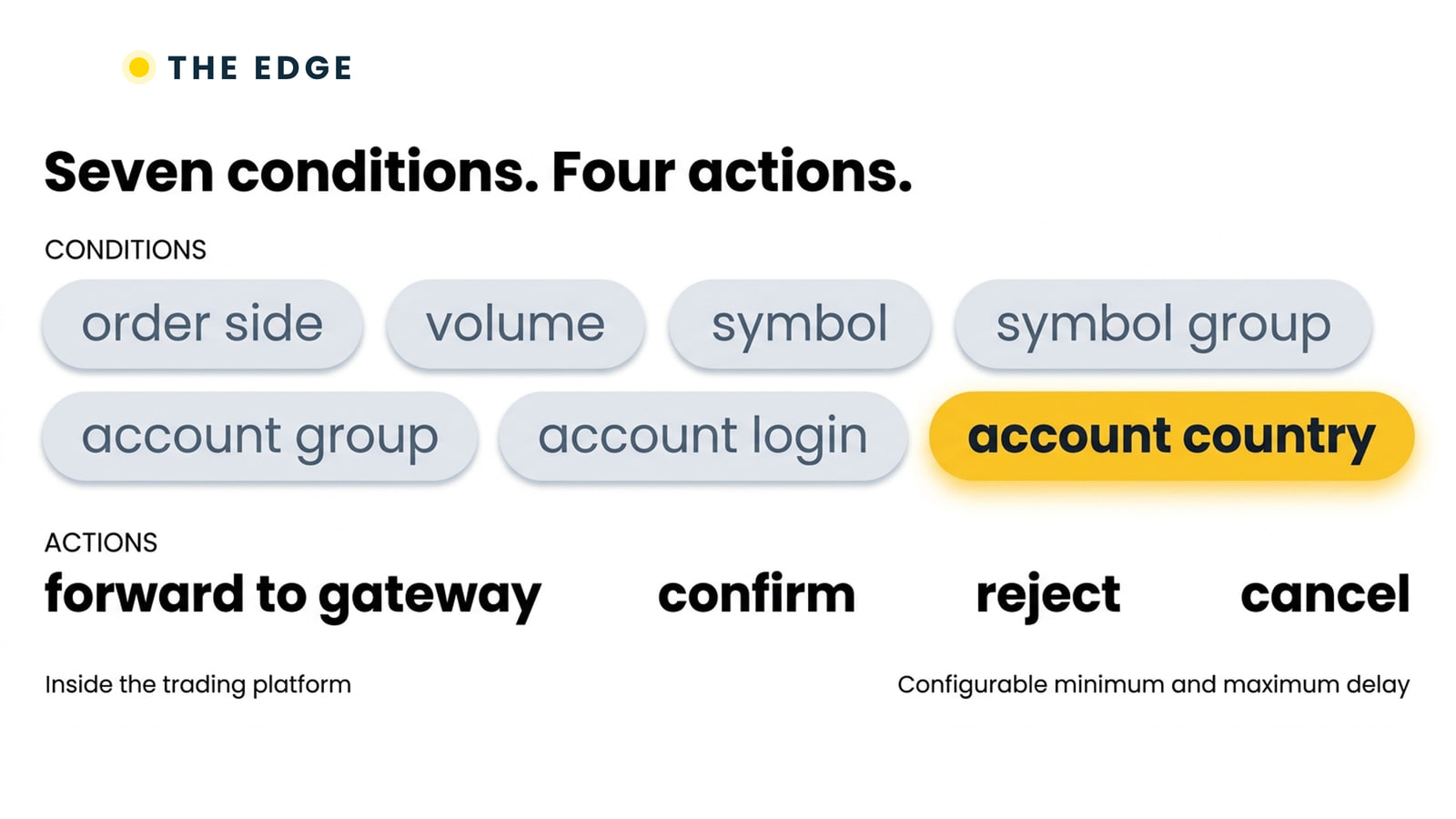
Conditions can be set on seven things: order side, volume, symbol, symbol group, account group, account login, and account country.
Four actions are available: forward the order to a gateway, confirm it, reject it, or cancel it. A configurable minimum and maximum execution delay sits alongside them.
Seven conditions and four actions is a small vocabulary, and that is the point. A routing policy you can hold in your head is a routing policy your desk can reason about at speed. Long condition lists produce configurations nobody dares change.
Why account country is the interesting condition
Six of the seven conditions are things a dealer expects. Account country is the one that tells you the engine was built by people running a real client base.
Regional differences are rarely about risk appetite alone. They are about which regulator the account sits under, which desk covers those hours, and which markets a client is realistically trading. Being able to express that in a routing rule rather than a spreadsheet of exceptions is the difference between a policy and a habit.
What this means for what you buy
Here is the part a brochure would leave out. If you run The Edge, you already have rule-based execution handling. You may not need to add a bridge yet.
That is not an argument against the Liquidity Bridge, which does considerably more: aggregation across venues, two markup layers, calendar-based spread control, arbitrage detection, failover on both sides. If you need those, the platform's routing engine is not a substitute.
But if what you actually need is conditional handling of your own order flow, it is already there, and paying for a second system to get it would be a poor use of your money. We would rather tell you that than sell you the larger thing.
Worth checking before you buy anything
- Write down your current routing policy in one paragraph. If you cannot, the problem is the policy rather than the software.
- Check whether any of your rules are really exceptions maintained by hand.
- Ask whether the conditions you need are the seven above, or something else entirely.
The third question is the one to bring to a vendor, including us. A capability list that does not include the condition your business turns on is not a capability list you can use.
The routing engine, the delay controls and the order handling are all part of The Edge. If you want to work out whether you need a bridge on top of it, describe your routing policy to us and we will tell you honestly.
More news

Two places to put a markup, and why the difference matters
A markup on the price stream and a markup at execution are different controls. How calendar-based spread limits and throttling fit alongside them.
Read more →
Sixty-five payment providers is not the number that matters
More than sixty providers integrated directly, per-country control of what each market sees, and a status-checking job per provider so states reconcile.
Read more →
The bridge should tell you before your client tells you
Feed and trade disconnections, failover switchover, price spikes, feed delay and dozens more, each schedulable so out-of-hours differs from the trading day.
Read more →
 +44 330 822 6201