
Sixty-five payment providers is not the number that matters
There are 65 payment providers integrated directly into our Back Office and CRM, counted from the integrations in the source. Alongside them sit crypto, digital wallets, local-agent networks and wire transfer as separate methods.
That total is the least interesting thing on this page. Two smaller mechanisms decide whether a payment stack works.
Showing every method to every market is a cost
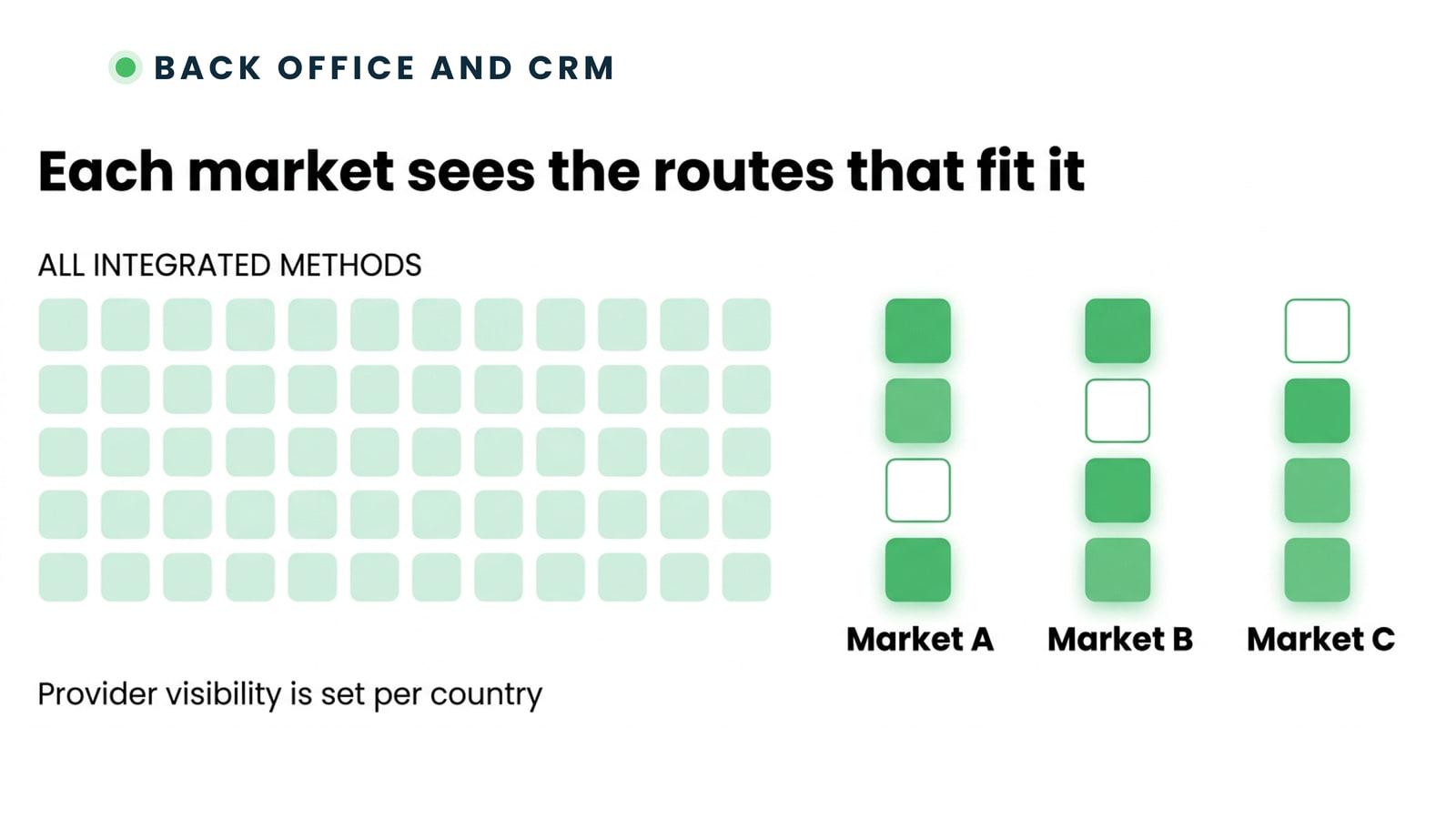
A trader in one country recognizes three payment brands and has never heard of the other sixty-two. Presenting all of them is not generosity, it is a decision to make the deposit page harder to use.
So provider visibility is controlled per country. Each market sees the routes that make sense for it.
The consequence is narrower than a conversion claim, and worth stating precisely: a shorter, more familiar list is easier for a client to complete. What that does to your numbers depends on your markets, which is why we do not publish an uplift figure.
Each provider has its own status-checking job
This is the mechanism that removes real work.
Every provider integration has its own status-checking job, so deposit and withdrawal states reconcile automatically rather than being chased by a person.
The failure it prevents is specific. A deposit is paid at the provider and still pending in your system. The client can see the money left their account. Your operator cannot see it arrive. Nobody has done anything wrong and there is now a support conversation, a manual check and a client who trusts you slightly less.
Multiply that by sixty-five providers and the work is not a queue, it is a department.
Withdrawals that do not need a person
Rule-based automatic withdrawals sit on top of that. An approved payout processes without an operator touching a ticket.
That only works if the status underneath it is trustworthy, which is why the two belong in the same conversation. Automating a decision on top of a number nobody trusts moves uncertainty downstream rather than removing it.
Three questions about your own setup
- How many of your payment methods does a client in your largest market actually see, and who decided that list?
- When a deposit is paid at the provider and pending with you, what closes the gap, a job or a person?
- What proportion of your approved withdrawals are touched by hand?
If the answer to the second one is a person, that person is your reconciliation system, and they are the constraint on how many markets you can add.
Payments, per-country control and the job engine are all part of the Back Office and CRM. If you want to go through your own provider mix and where the manual work sits, tell us which markets you are in.
More news

Two places to put a markup, and why the difference matters
A markup on the price stream and a markup at execution are different controls. How calendar-based spread limits and throttling fit alongside them.
Read more →
Execution routing that lives inside the trading platform
Seven conditions, four actions and a configurable execution delay, built into The Edge. Routing control without necessarily adding a separate bridge.
Read more →
The bridge should tell you before your client tells you
Feed and trade disconnections, failover switchover, price spikes, feed delay and dozens more, each schedulable so out-of-hours differs from the trading day.
Read more →
 +44 330 822 6201