
One exposure screen for a book that sits on four servers
A brokerage that grew has its book in more than one place. A MetaTrader 4 server that was there at the start, a MetaTrader 5 server added later, cTrader because a partner asked for it, and possibly a platform of its own.
Each of those has a screen. None of them has the answer.
What the Real-Time Vault does
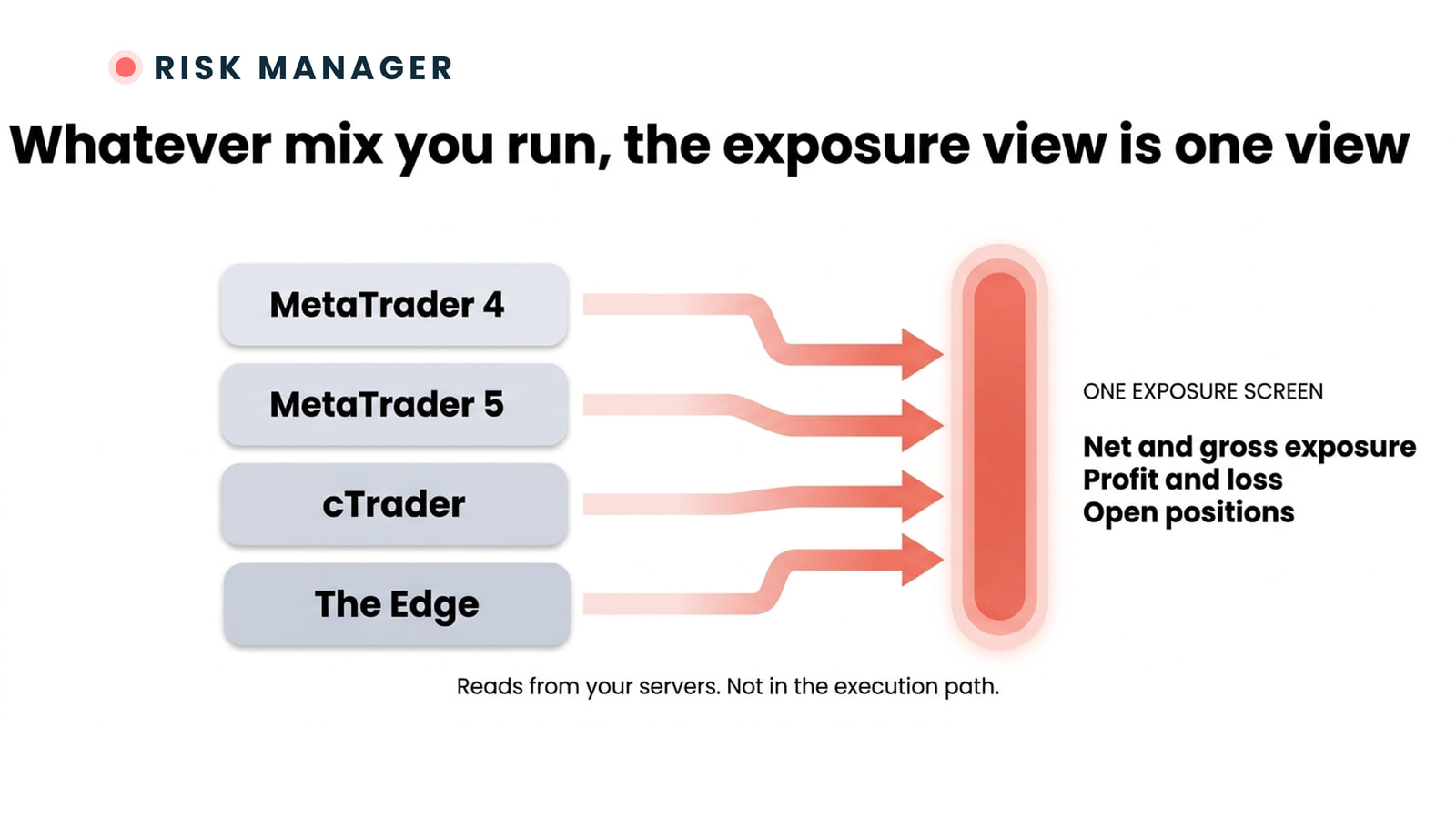
It aggregates net and gross exposure, profit and loss, and open positions from every connected trading server into one screen.
Risk Manager connects to MetaTrader 4, MetaTrader 5, cTrader and The Edge, each through its own dedicated connector. Whatever mix you run, the exposure view is one view.
That is a smaller-sounding claim than it is. The alternative is not a worse screen. The alternative is arithmetic, done by a person, under time pressure, on numbers that moved while they were adding them up.
Why the manual version fails in a specific way
It does not fail by being slow. It fails by being unowned.
When the consolidated number lives in a spreadsheet, somebody has to build it, and that person becomes the only one who knows which tab is current. Ask two people for group exposure at 15:00 and you get two answers, both defensible, because they were assembled at different moments from different tabs.
A desk cannot set a limit against a number like that. It can only react to it after the fact, which is the difference between risk management and incident review.
Reading, not acting
Risk Manager reads from connected servers and stays outside the execution path. It does not place, modify or block orders.
That is a deliberate trade. It cannot close a position when it sees a problem, and a broker who wants automated intervention should be looking at where their execution controls live. What the trade buys is a monitoring layer that is not another component in the path an order takes.
Three questions worth answering before you look at any product
Ask these about your own setup first, ours included.
- Who produces your consolidated exposure number today, and what happens the week they are on leave?
- How long is it between a position opening on your smallest server and appearing in your firm-wide view?
- If two departments quoted group exposure this afternoon, would the numbers match?
The third question is the useful one, because the answer is usually no and nobody is at fault.
Consolidated exposure, alerting and the funding view are part of Risk Manager. If you want to see it against your own server mix rather than staged data, tell us what you run and we will set up a walkthrough.
More news

Two places to put a markup, and why the difference matters
A markup on the price stream and a markup at execution are different controls. How calendar-based spread limits and throttling fit alongside them.
Read more →
Execution routing that lives inside the trading platform
Seven conditions, four actions and a configurable execution delay, built into The Edge. Routing control without necessarily adding a separate bridge.
Read more →
Sixty-five payment providers is not the number that matters
More than sixty providers integrated directly, per-country control of what each market sees, and a status-checking job per provider so states reconcile.
Read more →
 +44 330 822 6201